
Smartphone or tablet: read the label before you buy
7 November 2026 · 5 min read
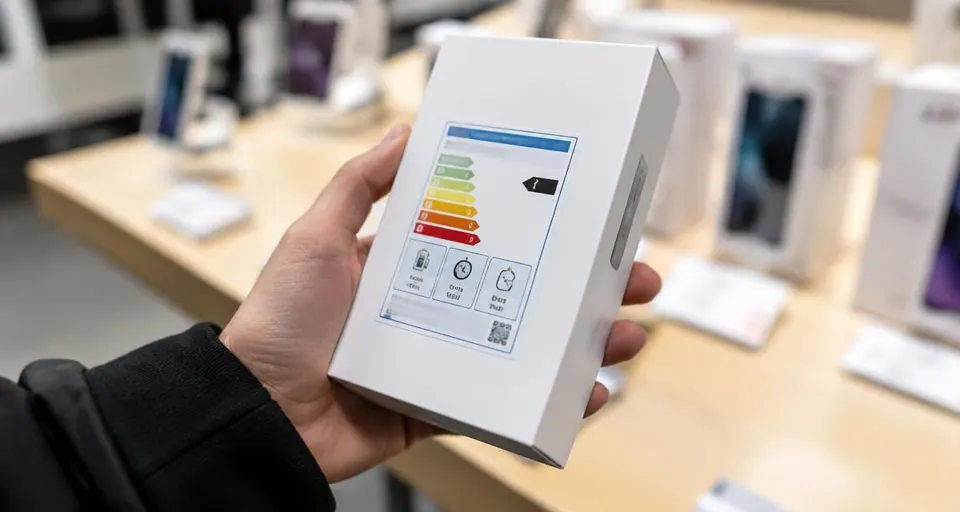
Since 20 June 2025, new smartphones and tablets sold in the European Union carry an energy label with a repairability score. Parts available for 7 years, longer-lasting batteries, free updates: here is what the rules require, and how to use them to choose well.
Two EU regulations, one date
Two texts have applied since 20 June 2025:
- Regulation 2023/1670 sets ecodesign requirements: spare parts, battery, updates;
- Regulation 2023/1669 requires an energy label on smartphones and tablets.
These rules apply to manufacturers and importers. For you, they mainly change two things: what you can read before buying, and your chances of getting a repair later.
What the label tells you
The label looks like the one on fridges. It must show:
| Information | What it tells you |
|---|---|
| Energy efficiency class (A to G) | Energy consumption |
| Battery life per charge (hours and minutes) | How long a full charge lasts |
| Battery endurance (in cycles) | How many recharges the battery withstands |
| Drop reliability class | Resistance to repeated drops |
| Repairability class | How easy repair is |
| IP rating | Protection against dust and water |
| QR code | Access to the full product sheet |
Tip: to compare two models at a similar price, look first at the repairability class and battery endurance. They often decide how long the phone really lasts.
The labelling regulation excludes devices with a rollable flexible screen and smartphones designed for high-security communications.
Spare parts: 7 years after sales end
This is the most useful rule in everyday life. The clock does not start when you buy, but when the model stops being placed on the market. For at least 7 years after that date, for smartphones:
- You can buy certain parts yourself: the screen, the back cover (if it must be removed to replace the battery), the SIM and memory card tray, the charger in some cases, and in principle the battery.
- Professional repairers have access to other parts: front and rear cameras, charging ports, buttons, microphone, speakers, hinge of foldable models.
Nuance for the battery: the manufacturer may reserve it for professionals if it is particularly durable (at least 80% of its capacity after 1,000 cycles, among other conditions).
Delivery times to repairers are also regulated: 5 working days during the first 5 years, then 10 working days for the following 2 years.
A battery designed to last
The regulation requires a smartphone battery to keep at least 80% of its capacity after 800 full charge cycles. For an idea: with one full charge a day, it takes a little over two years to reach 800 cycles.
System updates
When a manufacturer releases a security, corrective or functionality update, it must be available free of charge for all devices of the same model. This rule applies for at least 5 years. Security and corrective updates must also arrive no later than 4 months after the operating system provider publishes them.
What about tablets?
The same regulation covers tablets, with their own list of requirements. The logic is identical: parts, battery, updates and label.
Your checklist before buying
- Look for the energy label in the shop or on the online product page.
- Compare the repairability class and battery endurance.
- Scan the QR code to see the full product sheet.
- For an older model on sale, check that the energy label is displayed: it is mandatory for devices placed on the market since 20 June 2025.
- Keep your proof of purchase: if it breaks down within two years, the legal guarantee comes first.
Some phones and tablets are also among the products the manufacturer will have to repair, even after the guarantee. Our article on the right to repair explains it in detail.
The Garanti habit: Keep your proof of purchase and repair invoices in Garanti: if something breaks or the seller refuses, your claim file is ready in seconds. Try it free
Sources
- Regulation (EU) 2023/1670 — ecodesign of smartphones and tablets (EUR-Lex): Annex II, Part B
- Delegated Regulation (EU) 2023/1669 — energy labelling (EUR-Lex): Article 1 and Annex III
- DGE (France) — Lifespan of smartphones and tablets: the new rules (French)
Written by Pierre Leonet, founder of Garanti, on 7 November 2026. General information, not advice on an individual case.
Stay one step ahead
New rules and tips for your purchases, as soon as they are published.